

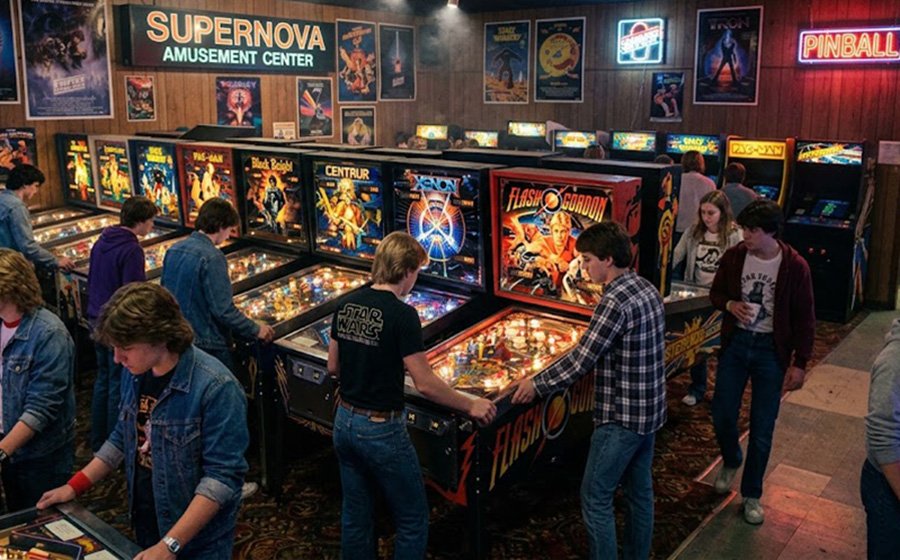
Pinball machines are one of the few collectibles where "vintage" isn't just a look — it's a completely different machine underneath the glass. Before you fall for a great-looking backglass, it helps to know what era you're actually buying into.
Electromechanical vs. solid-state
"EM" machines (roughly 1930s through the mid-1970s) score with mechanical relays and chimes, not a circuit board — that clunky, satisfying ka-chunk is the sound of an actual mechanism doing the counting. "Solid-state" machines (mid-1970s onward) swapped that for a scoring computer and digital displays, which is what let designers add the multiball, ramps, and speech that define the games most people picture when they hear "pinball." Neither is objectively better to collect — EM games are prized for their simplicity and repairability, solid-state for gameplay depth — but a listing that doesn't say which one you're looking at is a listing that hasn't told you the most important thing about the machine.
Names worth knowing
Gottlieb, Williams, and Bally dominated the mid-century era, with Stern picking up the Bally/Williams lineage after the 1999 pinball market crash and carrying the format into the present. Machines from designers like Steve Ritchie or artwork from Python Anghelo tend to command a premium among collectors who track individual credits the way record collectors track producers — it's worth a quick search on any machine's title before you commit to a price.
What to actually inspect
A machine can look incredible in photos and still be a money pit. Before buying, check for: playfield wear (especially in high-traffic shooter lanes and under the flippers — bare wood under the clearcoat is a real repair job), backglass condition (flaking paint on the back of the glass, sometimes disguised with touch-up paint from the front), whether the flippers and slingshots actually fire with authority or feel weak, and — on solid-state games — whether the original ROM chips and boards are still in the machine rather than swapped for reproductions. None of these are dealbreakers on their own, but each one is a real cost or a real value hit, so they belong in your offer, not a surprise after it arrives.
Provenance and storage matter more than people think
A machine with a known ownership history — especially one kept in a climate-controlled home rather than a damp basement or storage unit — is worth seeking out even at a premium. Humidity warps playfields and lifts art from the backglass over time; temperature swings are hard on solder joints and connectors. If a seller can tell you where the machine lived for the last twenty years, that's not a nice-to-know detail — it's the closest thing pinball has to a vehicle history report.
The short version: buy the era you actually want to play, inspect past the photos, and never underestimate what a good storage history is worth.