

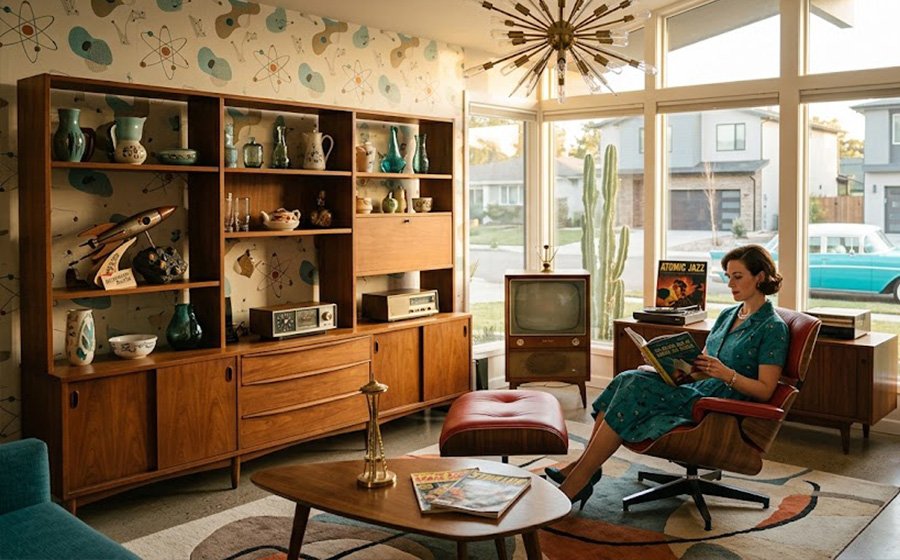
Rocket Rustler's whole aesthetic lives at the intersection of two eras that, on paper, shouldn't go together: the rugged, hand-tooled American Southwest and the shiny, forward-looking optimism of the Atomic Age. That second half has a real design history behind it, and it's worth knowing where the starburst clocks and boomerang shapes actually came from.
A world suddenly obsessed with the future
After World War II, atomic energy and aerospace engineering went from wartime secrets to civilian marketing overnight. The Soviet launch of Sputnik in 1957 turned that into a full-blown culture: TV antennas going up on every roof, "atomic" became a byword for modern and safe (long before the word carried its later anxieties), and everyday household objects — clocks, lamps, dinnerware — started borrowing shapes straight out of orbital diagrams and molecular models.
Googie architecture
Drive past a mid-century coffee shop or motel with a dramatic upswept roofline, a starburst sign, or a boomerang-shaped canopy, and you're looking at Googie architecture — named, almost by accident, after a Los Angeles coffee shop called Googie's, designed by John Lautner in 1949. The style was built for the car culture of the era: bold enough to catch a driver's eye at 40 miles an hour, and unapologetically futuristic at a moment when the future felt like something to look forward to rather than worry about.
The shapes that define the look
A handful of motifs carry almost the entire visual language of the era: the starburst (a direct nod to atomic diagrams and firework-like optimism), the boomerang or "amoeba" shape (borrowed from biomorphic modern art and the era's fascination with organic, free-form design), and the rocket fin (straight off of Cadillac tailfins and Cold War-era spacecraft concepts). George Nelson's "Ball Clock," designed for Herman Miller in 1948, is one of the purest distillations of the whole movement — a literal atomic-diagram silhouette turned into a functional object for the living room.
Why it still resonates
Atomic Age design was, at its core, optimism made physical — a visual bet that the future was going to be exciting rather than uncertain. That's a large part of why it pairs so naturally with vintage Americana rather than clashing with it: both eras share a confident, hand-tooled, slightly rough-around-the-edges belief that something better was just over the horizon. It's the same reason a starburst clock and a hand-carved cowboy relief print can sit on the same gallery wall and look like they were always meant to be there.